Category:
Geopolitical AnalysisIMEC Corridor Rebooted After Hormuz Challenges
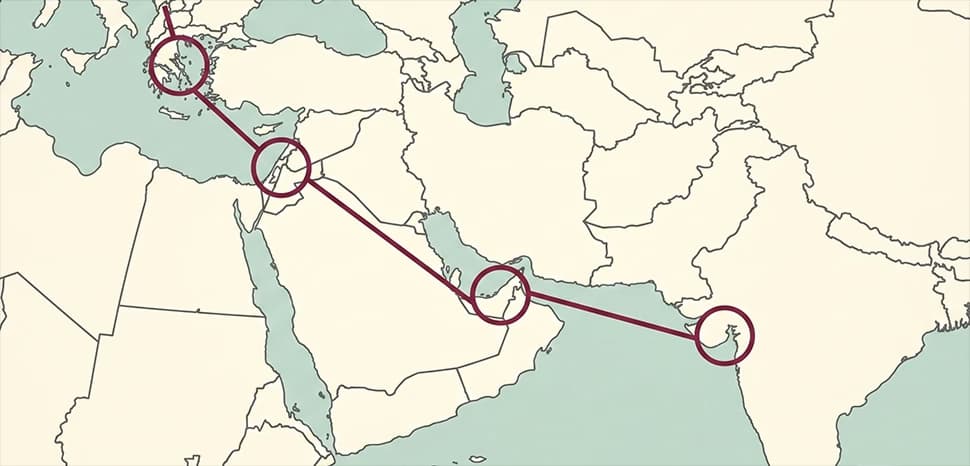
In 2023, the India-Middle East-Europe Economic Corridor (IMEC) emerged as a strategic initiative to mitigate dependency on traditional maritime routes like the Suez Canal. Aimed at countering China's Belt and Road Initiative, this corridor was poised to revolutionize the transportation of goods between India and Europe through a combination of shipping and rail across the Arabian Peninsula.
Navigating Chokepoint Vulnerabilities 🌊
The geopolitical landscape shifted dramatically in 2026 when tensions between the United States, Israel, and Iran led to a closure of the crucial Strait of Hormuz. This incident underscored a critical vulnerability in the IMEC's design, as it continued to rely heavily on unstable maritime routes vulnerable to regional conflicts.
Amid these challenges, the IMEC's strategy has evolved. Originally envisioned as an integrated multilateral corridor, it has pivoted towards bilateral agreements and projects independent of contentious routes. This includes advancements in data cables, green hydrogen, and electricity interconnections.
The Origins and Ambitions of IMEC 🚂
Announced at the G20 summit in New Delhi in September 2023, the IMEC brought together a coalition of India, the United States, Saudi Arabia, the UAE, France, Germany, Italy, and the European Union. Despite its ambitious goals, the initiative was hamstrung by its reliance on a memorandum of understanding that lacked binding commitments, making it susceptible to shifts in political alignment among its member nations.
The Strategic Pivot: Resilience and Innovation 🔄
In response to geopolitical instability, IMEC is undergoing a strategic transformation. By focusing on technological and energy projects, the corridor aims to build resilience and reduce dependency on risky maritime chokepoints. This includes:
- Data Cables: Strengthening digital connectivity across regions to support economic integration.
- Green Hydrogen: Investing in sustainable energy sources to fuel future growth.
- Electricity Interconnection: Developing cross-border electricity grids to ensure energy security.
These initiatives not only aim to fortify the corridor against geopolitical disruptions but also align with global trends towards sustainable development and technological advancement.
Broader Geopolitical Implications 🌍
The IMEC's challenges and adaptations reflect broader geopolitical dynamics. The corridor's evolution is emblematic of a world where infrastructure and connectivity projects must navigate complex international relations and security landscapes. As regional powers jockey for influence, initiatives like IMEC become battlegrounds for economic and strategic supremacy.
Future Prospects and Strategic Outlook 🔍
Looking forward, the IMEC must continue to adapt to the ever-evolving geopolitical climate. By leveraging bilateral agreements and focusing on innovation, the corridor can enhance its viability and contribute to a more resilient global supply chain. Key takeaways include:
- Flexibility: Adapting to geopolitical realities is crucial for long-term success.
- Collaboration: Strengthening partnerships to foster economic integration.
- Sustainability: Emphasizing green technology to future-proof infrastructure.
Conclusion 🌟
The IMEC's journey underscores the importance of resilience and adaptability in geopolitical projects. As the corridor seeks to reboot after the Hormuz stress test, its focus on innovation and strategic partnerships positions it as a potential cornerstone for future economic connectivity between Asia and Europe. The stakes are high, but with a clear vision and strategic foresight, the IMEC could emerge as a model for modern, sustainable infrastructure.
In the dynamic world of international relations, the IMEC's evolution is a compelling narrative of adaptation and ambition. As it navigates the complexities of global geopolitics, its success will depend on its ability to innovate and collaborate across borders.
You May Also Like

Geopolitical Analysis
Saudi Arabia's Bold Minerals Strategy
July 1, 2026
Geopolitical Analysis
Strategic Challenges in Securing the Strait of Hormuz
June 30, 2026
Geopolitical Analysis
Sovereignty, Airpower & Alliance Integration Limits
June 30, 2026
Geopolitical Analysis
Myanmar: A Renewed Frontline in India-China Tensions
June 29, 2026