Category:
Geopolitical AnalysisThai-Cambodian Maritime Dispute: MOU 2001 to UNCLOS
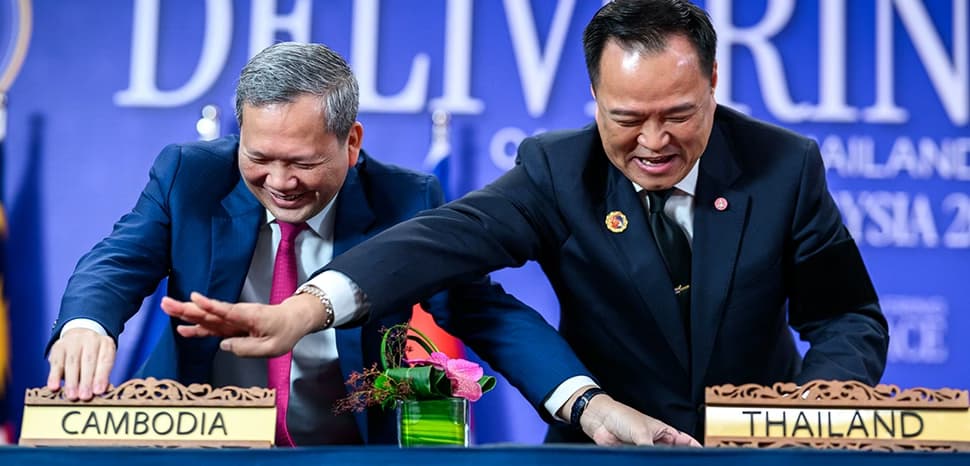
The Complex Web of Thai-Cambodian Maritime Dispute 🌊
The Thai-Cambodian maritime dispute is a geopolitical puzzle that has captured international attention. At its heart lies the Overlapping Claims Area (OCA), a contested maritime zone in the Gulf of Thailand, rich in potential oil and gas reserves. This dispute, dating back to 1972, has seen numerous twists and turns, with the recent withdrawal from the Memorandum of Understanding (MOU) 2001 by Thailand adding a fresh layer of complexity.
Historical Context: The Roots of the Dispute 🕰️
The origins of this dispute can be traced back to 1972 when Cambodian Prime Minister Lon Nol issued two presidential decrees, leading to Cambodia's unilateral maritime claims. In response, Thailand made its own counter-claim in 1973. The MOU 2001, crafted during a golden period of Thai-Cambodian relations, sought to address these overlapping claims by linking hydrocarbon exploitation to the settlement of the OCA.

MOU 2001: A Framework for Cooperation 🤝
MOU 2001 was signed to foster cooperation between Thailand and Cambodia, aimed at joint development of the rich resources within the contested area. However, the MOU's implementation has been fraught with challenges. The Joint Technical Committee established under the MOU met formally only twice, highlighting the difficulties in advancing the agreement.
The Vienna Convention Justification 📜
Thailand's decision to withdraw from MOU 2001 is rooted in provisions of the Vienna Convention on the Law of Treaties, specifically Articles 56.1.b and 56.2, which allow for treaty denunciation. Thailand argues that the lack of progress and Cambodia's refusal to engage in formal negotiations justify this withdrawal.
UNCLOS and the Path Forward ⚖️
Following Thailand's withdrawal, Cambodia initiated compulsory conciliation proceedings under the United Nations Convention on the Law of the Sea (UNCLOS). Both nations, however, have declared they do not accept compulsory arbitration, rendering the conciliation non-binding. This move could pave the way for renewed bilateral negotiations, potentially free from the maximalist positions of the past.
Political Posturing and National Interests 🇹🇭🇰🇭
The withdrawal from MOU 2001 can be seen as a strategic move by Thailand to gain domestic political favor. Prime Minister Anutin's stance offers a 'promises made, promises kept' narrative to the Thai public. Simultaneously, Cambodian Prime Minister Hun Manet positions himself as taking a firm stance against Thailand, appealing to national sentiments.
The Future of Bilateral Negotiations 🔍
Despite the withdrawal, both countries are likely to return to the negotiating table. The MOU 44 exit allows for discussions to separate resource exploitation from territorial disputes, aligning with future conditions at the land border. This strategic decoupling may create a more conducive environment for resolution.
Conclusion: A Path to Resolution? 🌟
The Thai-Cambodian maritime dispute remains unresolved, but the recent developments highlight a shift towards possible resolution. By moving away from maximalist positions and engaging in bilateral talks, both nations have an opportunity to settle their differences amicably. As the geopolitical landscape evolves, stakeholders and observers alike will watch closely to see how this complex issue unfolds.
You May Also Like

Geopolitical Analysis
Saudi Arabia's Bold Minerals Strategy
July 1, 2026

Geopolitical Analysis
Strategic Challenges in Securing the Strait of Hormuz
June 30, 2026

Geopolitical Analysis
Sovereignty, Airpower & Alliance Integration Limits
June 30, 2026
Geopolitical Analysis
Myanmar: A Renewed Frontline in India-China Tensions
June 29, 2026