Category:
Geopolitical AnalysisUAE Leaves OPEC: A New Era in Global Oil Markets

The United Arab Emirates' recent departure from the Organization of the Petroleum Exporting Countries (OPEC) marks a significant shift in global oil dynamics. This move, effective May 1, 2024, signifies a structural realignment in the geopolitical landscape of energy production. 🌍
Historical Context: UAE's Long-standing OPEC Membership
The UAE's decision to exit OPEC concludes nearly 59 years of membership, initiated in 1967 with Abu Dhabi's accession. The country's involvement has seen pivotal moments, such as the 1973 Arab oil embargo and the 1998 Riyadh Pact, establishing it as a key player aligned with Saudi interests. Over the decades, the UAE navigated through various oil market fluctuations, maintaining a strategic position within OPEC. 📈
Reasons Behind the Departure
Energy Minister Suhail Al Mazrouei and ADNOC Group CEO Sultan Al Jaber highlighted that the decision aligns with the UAE's national interest and true production capabilities. This move reflects a broader strategy to expand production capacity independently of OPEC's quotas, which have been a point of contention due to their asymmetrical application to UAE-wide output.
Impact on Global Oil Markets
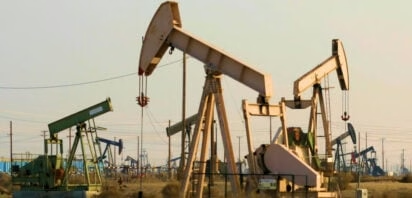
The UAE's exit comes amidst a backdrop of historical production cuts within OPEC, including a massive 27% contraction in March 2023. The decision also coincides with geopolitical tensions following the 2026 Iran war, which saw Brent crude prices peaking at $126 per barrel. The absence of the UAE, a major oil exporter, could lead to significant shifts in market dynamics and pricing strategies.
Potential Market Reactions
- Increased Volatility: The exit may introduce new volatility in oil prices as markets adjust to a redefined supply landscape.
- Bilateral Agreements: The UAE might pursue independent agreements, enhancing its influence outside the OPEC framework.
- Diversification of Partnerships: This move could encourage other nations to reconsider their positions within OPEC, potentially reshaping the organization's future. 🔄
Strategic Implications for the UAE
The UAE's withdrawal is not just a tactical move but a strategic one aimed at leveraging its vast oil reserves more effectively. By bypassing OPEC's production limits, the UAE can potentially increase its market share and invest in innovative energy solutions, aligning with global sustainability goals.
Economic and Political Considerations
- Economic Autonomy: Greater control over oil production allows the UAE to optimize revenue streams and reinvest in economic diversification, supporting its Vision 2030.
- Geopolitical Influence: The UAE's newfound independence could bolster its geopolitical clout, enabling it to negotiate more favorable terms in international arenas.
Conclusion: A Turning Point in Energy Politics
The UAE's departure from OPEC signifies a pivotal moment in energy politics, with far-reaching implications for global oil markets. As the UAE embarks on this new path, the world will be watching closely to see how this decision reshapes both regional and global energy strategies. 🔍
Looking Ahead
- Watch for Market Adjustments: Pay close attention to oil price trends and market stability.
- Monitor UAE's Strategic Moves: Observe how the UAE navigates its new role in the global energy sector.
- Consider OPEC's Response: The organization might need to reassess its strategies to maintain relevance without the UAE's contribution.
This structural realignment highlights the dynamic nature of global energy politics, where strategic decisions have the power to influence markets and international relations profoundly.
You May Also Like

Geopolitical Analysis
Saudi Arabia's Bold Minerals Strategy
July 1, 2026

Geopolitical Analysis
Strategic Challenges in Securing the Strait of Hormuz
June 30, 2026

Geopolitical Analysis
Sovereignty, Airpower & Alliance Integration Limits
June 30, 2026
Geopolitical Analysis
Myanmar: A Renewed Frontline in India-China Tensions
June 29, 2026