Category:
Geopolitical AnalysisCanada’s Indo-Pacific Strategy Challenges

Navigating the Shifting Indo-Pacific Landscape 🌏
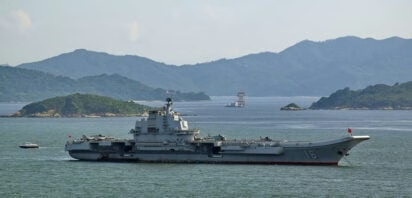
Canada's engagement with the Indo-Pacific region is unfolding amidst profound global shifts. The geopolitical center of gravity is moving towards Asia, a region that now accounts for a significant portion of the world's population and economic output. As the primary arena of trade flows and supply chain dynamics, the Indo-Pacific is also the focal point of strategic rivalry between the United States and China. In this context, even middle powers like Canada must adopt clear regional stances, as ambiguity can lead to strategic costs.
Canada’s Strategic Vision: Ambitions vs. Realities
Canada's Indo-Pacific Strategy, articulated in 2022, aims to convey sustained engagement, deepen economic integration, and reinforce security partnerships across the region. However, despite these ambitions, Canada's actual regional posture is marked by inconsistency and a gap between ambition and capability.
At the heart of this disconnect lies a tension in Canadian foreign policy: balancing economic interdependence with China—its second-largest trading partner—with deeper security alignment with the U.S., which views China as its primary strategic competitor. This duality has resulted in a policy environment where Canada expresses concerns about coercive economic practices and regional instability, yet avoids setting clear thresholds for engagement.
The Cost of Ambiguity
Canada's Indo-Pacific policy is characterized by various objectives—economic diversification, normative advocacy, and security cooperation—yet lacks a clear prioritization of these goals. This results in a reactive rather than directive posture, shaped more by external developments than internally defined strategic choices. In a region increasingly influenced by hard power competition and economic statecraft, this ambiguity is costly. It raises questions about Canada's reliability and limits its ability to convert commitments into influence.
Structural Challenges in Canadian Policy
The absence of clearly defined strategic thresholds is central to Canada's challenge. China’s expanding role in the Indo-Pacific demands that states delineate the limits of acceptable engagement. However, Canada's policy simultaneously characterizes China as disruptive while preserving avenues for economic interaction. This duality stems from unresolved prioritization among competing objectives—economic access, security alignment, and normative commitments.
Economic Coercion and Strategic Costs
In the context of economic coercion, where states face pressure through non-military tools like trade restrictions and supply chain manipulation, ambiguity becomes a strategic liability. For Canada, the lack of explicit red lines results in uncertainty both externally and domestically, leading to ad hoc decision-making often driven by immediate considerations rather than long-term strategy.
Aligning with the U.S. and the Way Forward
Canada's Indo-Pacific posture is closely aligned with the U.S., reflecting limited autonomy in defining an independent course. Shifts in Canadian policy often mirror changes in U.S.-China relations, indicating a reactive rather than proactive strategy.
Key Takeaways
- Strategic Clarity Needed: Canada must define clear priorities and strategic thresholds to effectively engage in the Indo-Pacific.
- Balancing Act: A nuanced approach balancing economic interests with security commitments is crucial.
- Proactive Engagement: Moving from a reactive to a proactive strategy will enhance Canada's influence and reliability in the region.
Canada's Indo-Pacific Strategy represents an opportunity to redefine its role in a dynamic and strategically vital region. By addressing capability gaps and enhancing implementation, Canada can strengthen its position as a reliable middle power, capable of navigating the complexities of the Indo-Pacific.
In conclusion, as the Indo-Pacific continues to evolve, Canada's strategic clarity and commitment will determine its success in this pivotal region.
You May Also Like

Geopolitical Analysis
Saudi Arabia's Bold Minerals Strategy
July 1, 2026
Geopolitical Analysis
Strategic Challenges in Securing the Strait of Hormuz
June 30, 2026

Geopolitical Analysis
Sovereignty, Airpower & Alliance Integration Limits
June 30, 2026
Geopolitical Analysis
Myanmar: A Renewed Frontline in India-China Tensions
June 29, 2026